A construction atlas for carrying things
Pocket names begin at the entrance.
Patch, in-seam, welt, slash, kangaroo, and cargo are six different ways to build a hole that holds things.
To name a pocket, find where the bag lives and how the hand gets in.
A patch pocket puts the storage on the outside. An in-seam pocket hides its opening inside a seam. A welt pocket cuts through the cloth and finishes the slit with narrow lips. A cargo pocket adds depth with pleats or gussets. Each one changes what the pocket can hold, what it does to the silhouette, and how much work it takes to sew.
The opening you can see and the bag you can’t work as a pair. A perfect welt can still lead to a bag too shallow for a phone. A generous bag can drag a fluid skirt out of line. Pocket design starts with an object, a hand, and gravity.
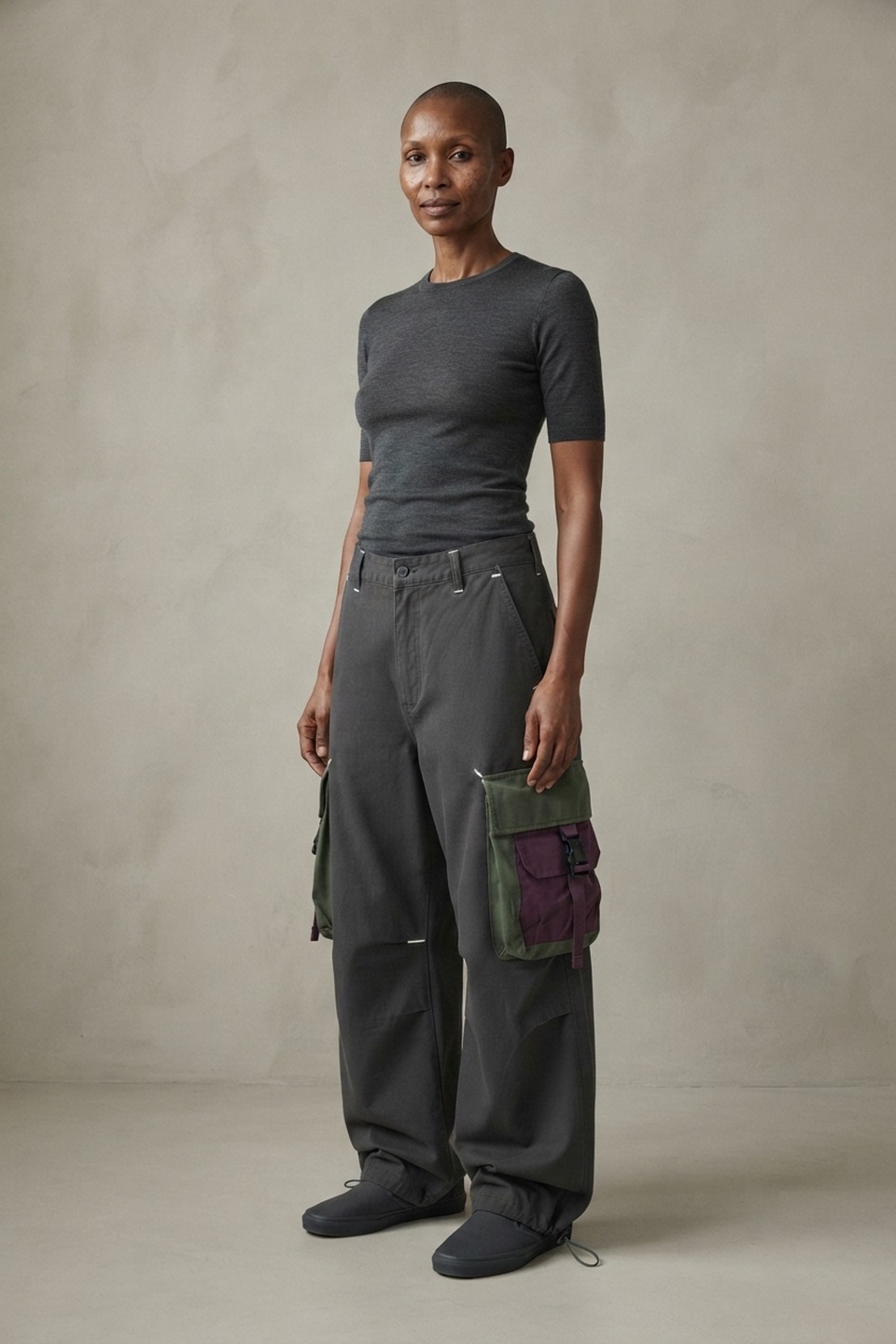 AI concept render
A separate piece applied to the surface
The opening borrows an existing seam
A cut opening is finished with narrow lips
An angled opening leads to an internal bag
Pleats or gussets create outward capacity
One front pouch usually serves both hands
The bag is where the object lives.
Most pocket talk stops at the opening. The bag underneath decides capacity and comfort. It has to be deep enough to hold the object below the opening, wide enough for a hand without turning into a sack, and rounded at the bottom so coins and lint don’t collect in corners.
Bag material matters as much as its shape. Self fabric is strong but bulky. Lightweight pocketing is thin but has to survive keys. Mesh shows the contents and drains water. A pocket can look rugged on the outside and fail because nobody thought about the cloth inside.
Invisible pockets hide the work inside.
An in-seam pocket keeps the outside plane clean, but the side seam now takes every hand and the weight of whatever’s in there. The bag can anchor into a waistband or facing to spread the load. Without that, the opening gapes and the garment sags.
Welt and jetted pockets look minimal because the complexity is on the inside. Cutting the opening can’t be undone. The corners have to be exact and reinforced, and the bag, facing, and welts have to line up without bulk. Looking simple takes real labor.
Every opening concentrates stress.
A hand pulls at the same two points every time it enters a pocket. That’s where bartacks, triangle stitching, and rivets go. A welt pocket depends on a stabilized cut in the body. A patch pocket needs strong top corners. An in-seam pocket sends its load into a seam that may need more support than the rest of the garment.
Heavier contents change the garment around them. A loaded cargo pocket pulls a light trouser leg outward. A phone in a chest pocket makes a shirt hang crooked. Reinforcement stops tearing, but it doesn’t cancel gravity. Sometimes the answer is a smaller pocket, a divided one, or a spot closer to the waistband.
Visible pockets edit the garment’s posture.
Patch pockets add seams, topstitching, and another layer of cloth. Set them high and a jacket feels compact. Set them low and the upper body reads longer and the hands rest lower. A curved opening feels different from a square one before either holds anything.
Cargo construction turns capacity into silhouette. An inverted pleat lies flat until it’s needed. A box pleat advertises volume. A gusset adds depth around the edge. Flaps, snaps, zippers, and hook-and-loop change how fast you get in and how safely things stay put.
Placement has to survive sitting down.
A trouser pocket that feels right standing up can be unreachable in a chair. A hand-warmer pocket can collide with a backpack hip belt. A rear pocket puts a phone under the wearer. Reach, handedness, layers, and what people actually carry all complicate a spot that looked fine on the flat drawing.
Tape a paper pocket on or baste one in before you perfect the construction. Put the real object in, move around, take it out a dozen times, and watch whether the opening gapes or the garment rotates.
Not every hand is the same.
Opening width, closure force, depth, and reach decide whether a pocket works for different hands. A tiny zipper pull is hard with gloves or limited dexterity. A rear opening is out of reach from a seated position. A deep unstructured bag swallows small objects. Dividers and a key tether often do more than raw volume.
Test with the people and conditions in the brief. If the garment is adaptive, workwear, or just meant for daily independence, prove the pocket opens from the positions that matter. You can’t design for every hand at once, so say whose you’re designing for.
Closures trade speed for security.
An open patch pocket gives instant access and no containment once the garment turns upside down. A flap adds weather protection and a visual layer. A snap is quick but loads one point. A button is slow and repairable. A zipper secures the whole opening and adds stiffness, hardware, and something to snag a knuckle on.
Match the closure to the risk. A decorative chest pocket may need nothing. A cycling pocket holding keys needs a real barrier. A cargo pocket for gloves has to open with cold fingers.
Who got pockets is part of the history.
European women once wore separate tie-on pockets under their skirts, reached through slits in the layers above. Later fashions gave women’s clothes smaller or less useful pockets than menswear, and the handbag turned storage into a separate purchase. The complaint about women’s pockets is old, and it’s about who gets to carry their own things.
None of that means every garment needs a cargo bay. It does make “the line looked cleaner without one” a decision worth examining. Who is expected to carry the phone, the keys, the medication somewhere else?
Design around the contents.
Name the biggest object, which way it sits, and whether the wearer has to reach it sitting down or on the move. A phone pocket needs depth and an opening that won’t let go. A hand-warmer pocket needs a comfortable angle. A tool pocket may need reinforcement and a divider.
Prototype with weight inside. Clothes photographed empty hide the forces of use. Put in the keys, the phone, the wallet, then walk and sit.
Specify the pocket, then load it.
Specify the opening type and length, its location from stable landmarks, the bag’s size and material, reinforcement, closure, and what it’s expected to hold. For a bellows pocket, show the pleat depth and how it lies when empty. For a waterproof shell, say how the needle holes are sealed.
Then judge the sample twice: empty and loaded. Empty, the pocket is part of the silhouette. Loaded, it’s equipment. Either way the outside should tell the truth about what it can carry.
A pocket works when the hand finds it.
The best pocket is the room whose entrance meets the hand, whose walls hold the object, and whose weight the rest of the garment is ready to carry.