The number inside the cloth
GSM is weight, not quality.
Fabric weight predicts part of a T-shirt. Yarn, knit, finish, and gravity decide the rest.
Two T-shirts can share a GSM and feel like they were made on different planets.
GSM means grams per square meter. Cut a square meter of cloth, weigh it, and that’s the number. It’s useful because it describes the cloth without the garment size getting in the way. It says nothing about the fiber, the knit, the finish, or what happens in the wash.
Heavier jersey bridges over the body and holds a boxier line. Lighter jersey falls closer, moves faster, and lets more light through. Neither is better. And a dense fine-gauge knit and a bulky open knit can land on the same weight by completely different routes.
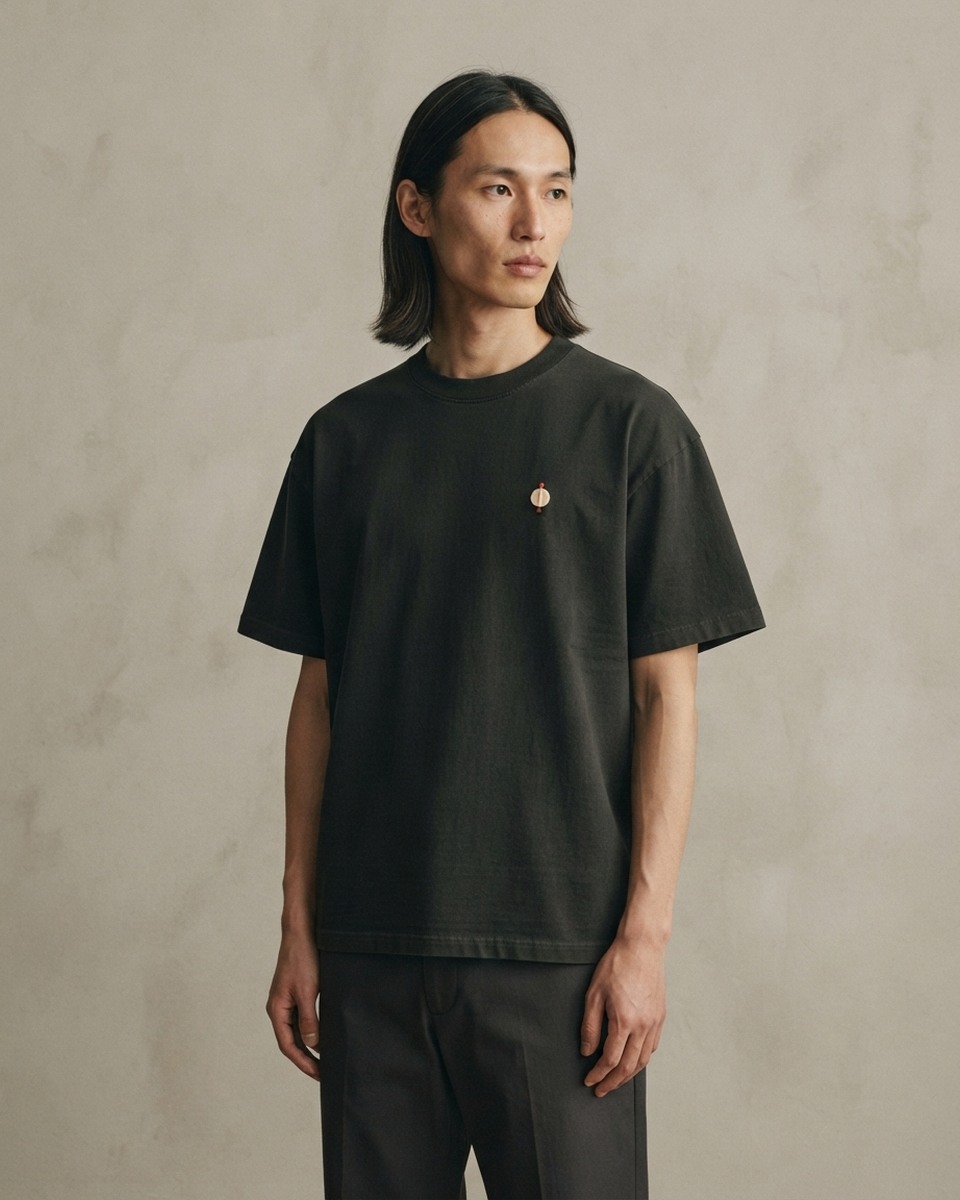 AI concept render
Very light; test opacity and recovery
Light to everyday
Noticeably more body
Substantial; construction becomes visible
Heavy; heat, drying, and bulk matter
How GSM gets measured.
A mill or a lab cuts a known area of fabric, weighs it, and converts to grams per square meter. The number looks absolute, but cloth varies across a roll and shifts with moisture, washing, and finishing. A spec needs a tolerance.
Finished garment weight is a different number. An XL uses more cloth than an S. Rib, labels, thread, prints, and trims add mass. Two shirts in the same 220 GSM jersey won’t weigh the same if one is cropped and the other reaches the thigh. GSM lets you compare the cloth before garment size muddies it.
Weight comes from several places.
Thicker yarn adds weight. More loops per square centimeter add weight. Compacting squeezes a cloth denser, while brushing makes it feel bigger and softer without adding much. Cotton, polyester, viscose, and blends all differ in density and how they hold moisture.
So shopping by GSM alone disappoints. The number only means something next to the fiber, the yarn, the knit, and the finish.
Construction decides where the mass goes.
Single jersey has a distinct face and back, stretches across the width, and curls at cut edges. Interlock is a balanced double knit, smoother and more stable. Rib forms vertical columns with strong crosswise stretch. Sweatshirt fleece and French terry add loops or brushing on the inside. All of them can be described by weight. None of them spend it the same way.
A 220 GSM single jersey makes a substantial T-shirt. The same number in a looped sweatshirt knit feels light, because some of the mass went into loft and surface. GSM without the knit type is like describing a building by its tonnage without saying whether it’s a bridge or a house.
Yarn and finish decide the feel.
Fine yarns make a smooth, compact surface. Coarser yarns make texture you can see. Twist, fiber length, and blends change fuzz, strength, luster, and hand. Then finishing washes, compacts, brushes, sands, coats, or softens the cloth. The “buttery” or “dry” feel a shopper notices can owe as much to that last step as to the number on the spec sheet.
Finishes also age. Softener washes out. Raised fibers flatten or pill. A resin that gave crispness relaxes. Cloth changes; that’s normal. But don’t confuse the first touch in a showroom with the fifth month of wear. Wash testing is how you meet the future version of the fabric.
Weight changes how the pattern behaves.
Light cloth stretches under its own weight, curls at cut edges, and shows every ridge underneath. Heavy cloth resists gathering, piles up at the neckband, and can make a big hood pull backward. The pattern has to be drawn for the cloth, because not all jersey is interchangeable.
Heavyweight streetwear tees pair dense cloth with a wide body, dropped shoulders, and sturdy rib. Copy only the GSM and the effect disappears. The silhouette comes from the proportions and the material working together.
Washing can twist the whole shirt.
Knitted loops hold tension left over from spinning, knitting, dyeing, and finishing. Water, heat, and movement let some of it go. The shirt gets shorter, narrower, or both. The side seams can rotate toward the front and back, a twist called torque or spirality. A perfect fit in untested cloth can be a different garment after one wash.
Good development measures before and after a defined wash cycle: length, width, neck opening, seam rotation, recovery. Preshrinking or compacting reduces the change, and a pattern can sometimes build in predictable shrinkage. The real move is to replace “pre-shrunk” as a comforting adjective with a test and an acceptable result.
Color changes how heavy the cloth looks.
Pale cloth shows transmitted light and the shadows under it, so a light tee reads thinner than the same knit in black. Dye and finishing routes can change hand and dimensions too. Heather effects come from blended or differently colored fibers and can have a surface unlike a solid shade.
Test opacity in the actual color, stretched the way the shirt will be worn, against both a light and a dark background. A nominally heavy white jersey can show more than a lighter black one.
Use your hands, then use the number.
Fold a swatch over an edge and watch the curve. Stretch it across and down, and see how fast it comes back. Hold it up to the light. Crush it in your fist. Wash it the way the wearer will. A product listing can’t tell you any of that.
Choose the weight from what you want to feel: cool or insulating, fluid or structured, quick-drying or substantial. The right GSM is whichever one gets you there with the knit and fiber you’ve chosen.
Start from how the shirt should feel.
For a summer layer you want airflow, quick drying, low bulk, and enough opacity for the color. For a boxy graphic tee you want a surface that prints cleanly, a neck rib that recovers, and enough body to hold the shirt off the torso. For a base layer, softness and stretch recovery matter more than structure. None of those briefs starts with “highest GSM available.”
Order a few swatches near the target weight and compare them after washing. Drape each over the same edge and hang equal pieces overnight. The winner is the one that behaves the way the shirt needs, whatever its number.
Quality means fit for the job.
A good T-shirt fabric suits its job and can be made again the same way: even knitting, acceptable shrinkage, stable color, strong seams, a hand that survives care. A featherweight running tee and a dense workwear tee can both be excellent and share almost no numbers.
Ask which failures matter most. Does the neck grow? Do side seams twist? Does the surface pill? Does the cloth stay wet? Quality gets concrete when it’s written as tolerances and tests. Without those, “heavyweight” is just a price signal.
The number is useful inside a sentence.
Ask for a dense 220 GSM cotton jersey with a dry hand and firm recovery, not a “premium heavyweight tee.” The first gives a fabric developer something to test. The second gives them a mood.