Four ways to put an image on cloth
The artwork chooses its machine.
Screen print, DTG, DTF, and embroidery each rebuild the same image in a different material.
Decoration is translation. Pixels have to become ink, film, or thread on a surface that stretches, wrinkles, and goes through the wash.
A design on a screen has no thickness, no stretch, no nap, no seams, and never goes through a wash. The moment it lands on clothing, all of that arrives. Screen printing pushes ink through a stencil. DTG jets ink straight onto the garment. DTF prints onto film and transfers the image with adhesive. Embroidery redraws the image as paths of thread.
There’s no best method. It depends on the artwork, the quantity, the colors, the fabric, where it sits, how it should feel, and what it has to survive. Pick by fashion alone and you miss the machinery that makes the result.
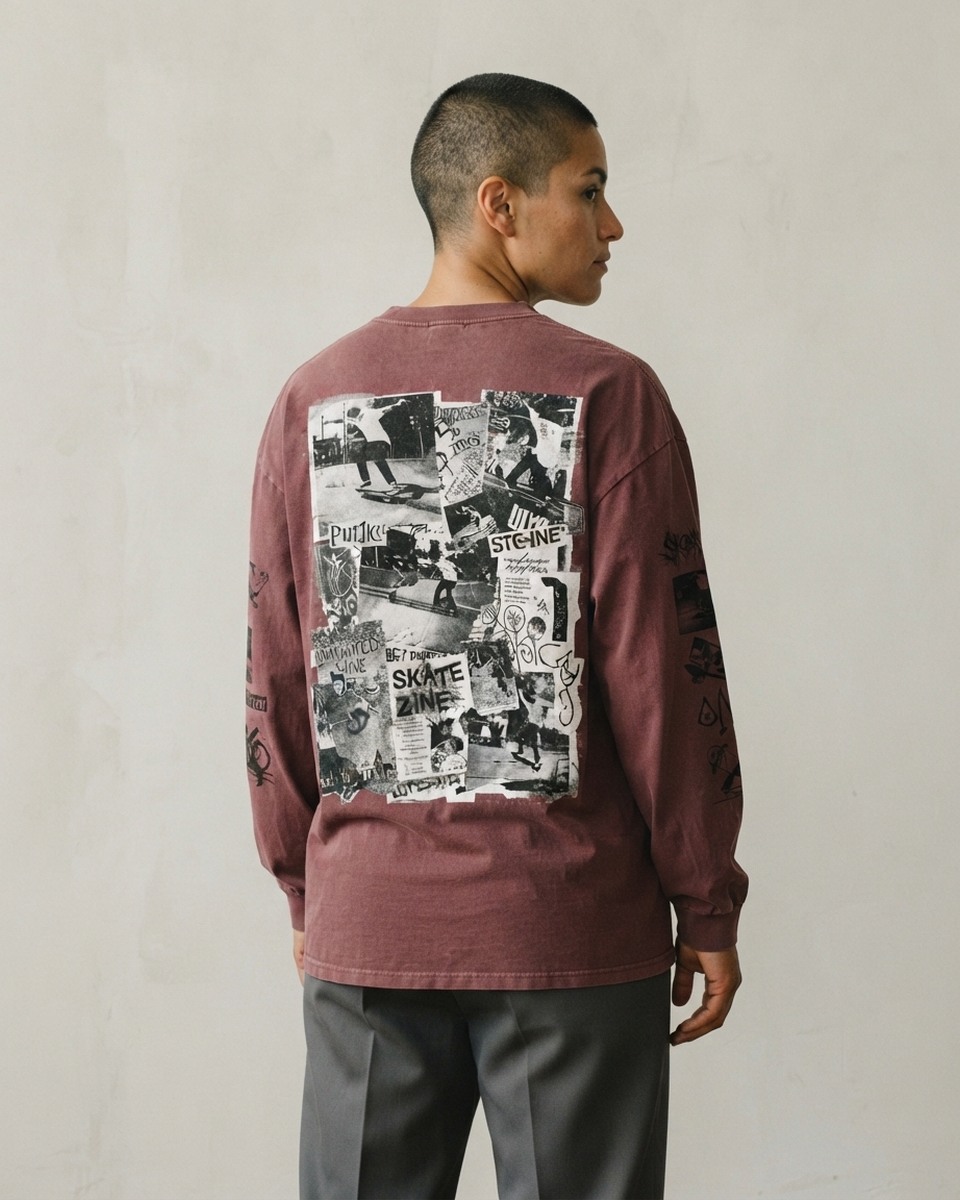 AI concept render
Repeat a prepared color layer, fast
Jet detailed digital color onto a flat garment
Transfer a printed film image with adhesive
Build color and line from physical thread
Each method rebuilds the file differently.
Screen printing separates an image into printable colors, one screen and ink layer each. DTG treats the garment like inkjet paper and can hold continuous tone. DTF prints onto a carrier film, adds powdered adhesive, then transfers the whole layer. Embroidery software turns shapes into stitch paths, densities, underlays, and directions. A “high resolution” file can still be unprepared for all four.
Fine type, translucent shadows, tiny gaps, and big flat fields stress each process differently. A printer traps colors so a small registration shift doesn’t leave a white hairline. An embroiderer enlarges a letter so thread can describe its counter. Production artwork is a translation that keeps the important thing alive under new physical rules.
Sharp detail and true color are different problems.
DTG holds gradients and photographic detail, but color shifts with pretreatment, ink set, fabric color, and surface. Screen print delivers saturated spot colors and specialty inks, but every color and effect adds setup. DTF keeps crisp small shapes, though big solid areas can feel like a sticker.
Embroidery is interpretive on purpose. Fine lines thicken, small counters close up, and gradients become thread decisions. On fleece, towels, or other raised surfaces, underlay and stitch direction decide whether the art sits clean or sinks into the nap.
Dark cloth makes color a chemistry problem.
A bright image on black needs an opaque base or a white underlayer, or the garment color swallows it. DTG uses pretreatment and white ink. Screen printing lays an underbase and builds colors on top. DTF arrives as an opaque transfer. Each route changes feel, edge, color, and curing compared with the same image on white.
Garment dyes can migrate or react under heat, especially in some synthetics. Test the exact color and fabric rather than a convenient blank that looks close. In decoration the background is an active ingredient. The image and the shirt make a third color together.
The print has a feel.
Printers say “hand” for how a print feels on the fabric. A thick ink deposit makes a rubbery plate. Water-based ink sinks into some fibers and feels more like cloth. A DTF transfer is a film-and-adhesive layer whose flexibility changes with coverage. DTG stays soft in an open image but usually needs pretreatment, especially on dark garments.
Embroidery adds the most obvious structure. Thousands of stitches add weight and stop the cloth stretching underneath them. On a cap or a jacket that’s exactly right. Across a light jersey chest it pulls, puckers, or scratches. Judge a big decorated area as a panel of material: it bends, traps heat, and touches skin.
A garment is uneven terrain.
A press wants a flat, stable surface. Seams, plackets, pockets, zippers, and rib change height and pressure. Move a print two centimeters away from a pocket and it can transfer cleanly where the first position didn’t. Sleeve and hood prints need fixtures built for narrow or layered shapes. “Anywhere on the garment” is a promise production has to earn.
Embroidery needs room for a hoop and enough stability under the needle. Backing supports soft cloth; topping stops stitches sinking into pile. A chest logo on fleece, a cap front, and text beside a zipper need different prep even with the same thread. Decide placement when you choose the process.
Durability begins before the wash test.
Ink has to suit the fiber and cure at the right time and temperature. Adhesive has to bond without scorching the garment. Thread, needle, backing, and stitch density have to suit the cloth. Failures show up at the edges: a transfer lifting at a corner, ink cracking where stretch concentrates, stitches cutting a fragile knit, dye bleeding into a pale print.
A real test follows the care the shirt will actually get. Wash it several times, dry it as instructed, stretch the decorated area, and compare color, adhesion, shape, and hand. One pristine sample proves little. So does the story that one process “lasts forever.” Durability belongs to a specific artwork, recipe, garment, and care cycle.
Quantity sets the price.
Screen prep and color setup are fixed work that spreads across a long run. Digital methods skip most of that and make one-offs practical, but ink, pretreatment, film, adhesive, and machine time still cost per unit. Embroidery is priced mostly by stitch count, size, and handling. No method has one price independent of the art.
Get quotes on the same garment, placement, size, colors, quantity, and quality standard. Ask for sample and setup costs separately. A low unit price at a quantity you can’t sell isn’t a saving. It’s a pile of boxes.
Match the method to what matters most.
A few bold colors across hundreds of similar shirts: screen printing earns its setup. Photographic, frequently changing, or small-run: DTG keeps more of the image with less fixed prep. Detailed, colorful transfers across many placements and fabrics: DTF, with feel and adhesion to check. Thread, relief, and permanence as part of the object: embroidery.
Hybrids are often more interesting than loyalty to one process. A screen-printed field under an embroidered mark. A small stitched emblem balancing a big digital back print. Give each method the part of the image it does best, and ask what the image has to become once it’s no longer light on a screen.
Choose the failure you can control.
Every method has its own way of going wrong: setup, color range, film feel, puckering, abrasion, or a fabric it can’t handle. Name the one requirement that can’t move, then test the method most likely to protect it.