Why cloth chooses a curve
Drape is a negotiation with gravity.
Fiber matters. Yarn, weave, knit, weight, finish, and cut decide how cloth falls.
Drape is the shape cloth takes when its own weight pulls against its structure.
Hang organza and charmeuse from the same point. One stands out and holds space; the other collapses into narrow folds. Both can be silk. Fiber names the raw material. Construction turns it into a different mechanical object.
A fabric drapes through bending, shearing, stretching, friction, thickness, and weight. Finishing can relax, compress, coat, brush, or stiffen it. Then the pattern points all of that around a body. “Flowy” is the visible end of a lot of hidden decisions.
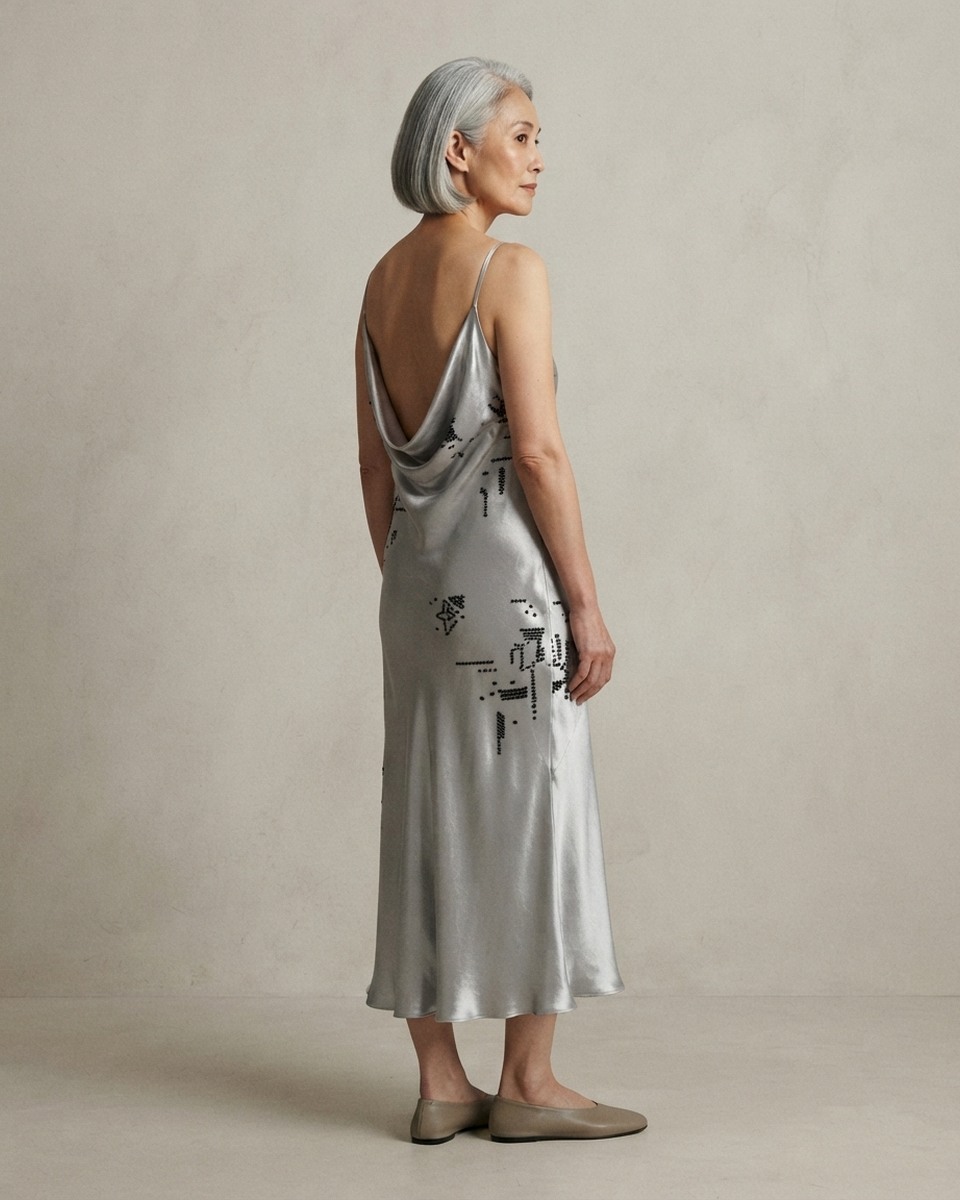 AI concept render
Does a fold arc broadly or collapse tightly?
Can yarn systems shift diagonally?
How strongly does the cloth pull itself down?
Does it spring back after stretch or crush?
Do layers slide, cling, or catch?
Drape begins with resistance to bending.
Hold a swatch over your hand. If it sticks out in broad planes, it resists bending. If it collapses into tight folds, it bends easily. Weight pulls the cloth down, but stiffness decides how big the curves are on the way. So a heavy wool coating can look more architectural than a lighter silk.
Shear matters too. For cloth to wrap a three-dimensional body, its yarns or loops have to slide against each other. Surface friction decides whether layers glide or cling. Stretch decides whether the cloth drapes by folding or by extending. “Fluid” is what you see when several of these forces cooperate.
Weight can create fluidity or defeat it.
Extra weight helps fine cloth fall into long, decisive folds. The same weight in a thick, stiff structure just makes bulk. Read thickness, stiffness, and weight together. Heavy isn’t automatically fluid, and light isn’t automatically airy.
Scale matters too. A small swatch can look crisp because there isn’t enough cloth for gravity to work on. Hang a bigger piece at the real garment length and move it. You can’t judge drape on a tabletop.
Wovens and knits bend differently.
A woven interlaces straight warp and weft yarns. It can be as open as gauze or as dense as canvas, but it stretches least along the yarns and most on the diagonal. A knit is a field of connected loops that change shape, so it extends and recovers without any elastic fiber.
You can see the difference in silhouette. Jersey lengthens under its own weight and wraps curves with few darts. Taffeta holds space between cloth and body. Twill combines diagonal give with a sturdy face. The fiber name alone can’t predict any of this.
Grain decides which way the cloth gives.
Pattern pieces normally sit on the lengthwise grain for stability. Rotate them and the same cloth changes. A bias-cut piece hangs closer to the fabric’s diagonal, where a woven deforms most readily, so the garment clings, lengthens, twists, and falls into narrower folds. Madeleine Vionnet built whole dresses around that behavior.
Bias has costs. Seams grow while you sew them. Hems keep dropping after the garment is hung. Slippery layers shift. A good bias design lets the pieces relax before the final leveling and gives the cloth enough uninterrupted area to show why it was rotated.
Finishing rewrites the hand.
Washing relaxes a weave. Calendering presses the surface flat. Brushing raises fibers and adds loft. Resin or coating adds crispness. Pleating stores a repeated shape. Even dyeing can change the hand. The cloth that comes off a finishing line is a different object from the greige cloth that went in.
Construction adds another layer. Interfacing stiffens chosen areas. Lining changes friction and hangs as a second layer. A double-fold hem swings differently from the body above it. Designers shape drape by deciding where the cloth stays free and where it gets held.
Labs can put numbers on some of it.
Textile tests measure mass, thickness, stretch and recovery, bending, friction, and a drape coefficient, taken from the shadow a circle of cloth casts when it hangs over a smaller disk. The numbers make comparison consistent. They don’t rebuild the garment, where seams, cut, and a moving body add new conditions.
Use the data to narrow choices and chase changes. If a new lot suddenly hangs differently, a test can tell you whether weight, stiffness, or finish moved. Then go back to touching the cloth.
Test drape at the scale of the garment.
A swatch shows hand, curl, and stretch. It can’t show how two meters of cloth hang from a shoulder or gather into a skirt. Pin a real length on a stand or a body. Cut a quick half-scale shape. Hang it overnight. Add the lining, the pocket, or the hem weight the final design will carry.
Write down what you see as verbs with conditions: falls in broad cones, clings after static, collapses at the waist seam, grows three centimeters overnight, sticks to the lining when walking. Those notes tell the next sample what to confirm. “Beautiful drape” doesn’t.
Wear supplies heat, moisture, wind, and time.
A fabric that falls cleanly in a studio may cling with static outside, soften with body heat, or lift in wind. Knees and elbows flex it all day. Sitting stores folds. Over hours, some cloth recovers and some keeps a record of the day in wrinkles.
That can be part of the pleasure. Linen turns into a map of movement; a resilient knit keeps returning to its first shape. Decide which of those changes belong to the design and which count as failure.
Specify the verb you want.
Should the skirt swing away, skim and release, cling, ripple, or stand? Should a sleeve collapse at the wrist or hold a rounded volume? Those verbs are testable in a way “luxurious” and “nice drape” are not.
Pair the verb with a reference and the construction facts. Then approve the actual cloth, not the description. Two mills can supply fabrics with the same composition and weight that move differently, because the yarn, construction, and finish changed.
The silhouette keeps moving.
A drawing holds one instant. Cloth keeps going. Good material direction describes the outline at rest and how the garment gets there, leaves it, and settles afterward.