The physics hiding in the pattern
Fabric has a direction.
A dress can be stiff, fluid, stable, or alive before its first seam is sewn. What the cloth is made of matters. Which way you turn it matters just as much.
Take a scrap of woven cloth and pull gently along its length. Try across its width. Then pull diagonally. That last direction will usually give more: the yarns can change angle where they cross, even when the yarn itself has little stretch.
That small movement runs a surprising amount of clothing. Turn a pattern piece 45 degrees and its long edge lies on the bias. The cloth may bend around a curved edge or settle closer to the body. How much it moves still depends on the fabric; turning a stiff canvas won’t make it behave like silk charmeuse.
Designers call this orientation grain. It sounds like housekeeping, the arrow printed on a paper pattern that you obey without thinking about it. But grain decides which direction resists, which direction gives, and how gravity travels through the garment.
A woven fabric is a grid under tension.
Woven cloth interlaces two systems of yarn. The warp runs lengthwise, parallel to the finished edges called selvedges. The weft crosses it. Lengthwise grain is often more stable than crossgrain, but yarn, weave, finishing, and elastic fibers can change that relationship. Test the cloth you have.
A diagonal direction is called bias; true bias is exactly 45 degrees to warp and weft. Pull there and the crossings can change angle. This helps explain why a bias strip can bend around a curve even when the fabric contains no elastane. The lab below isolates that one movement.
So “100% silk” tells you less than you’d think. Silk organza stands away from the body like a lampshade. Silk charmeuse skims it like liquid. Same fiber; the yarn, the weave, the finish, and the grain did the rest.
Grain lab · interactive
Pull a thread. Then pull between threads.
Here is a square of plain-woven cloth: cobalt warp running along the selvedge, saffron weft running across. Pull it top to bottom on the straight grain, then turn it to the bias and pull again.
- Warp · along the selvedge
- Weft · across
- Selvedge
- Cloth at rest
- Pull
Crossing angle in this diagram: 90° (at rest: 90°)
Straight grain: the pull runs along the warp, the lengthwise yarns parallel to the selvedge. This model keeps those yarns the same length, so the grid holds its shape. In real cloth, yarn crimp, elastic fibers and other properties can still allow movement.
- Bias binding rounds an edge. A strip cut at 45° can shape itself around a curved neckline or armhole, where a straight-grain strip tends to pucker or stand away.
- Bias pieces can grow as they hang. Gravity pulls a bias-cut skirt much as the slider does, so hang the garment and test it before leveling the hem.
An idealized crossing-yarn model, not a fabric or fit simulator. Yarn lengths stay constant while the crossings pivot, and the straight grain is held fixed on purpose. The slider is an illustrative pull position, not a calibrated load or a predicted stretch. Real cloth also answers through yarn crimp, fiber elasticity, friction between yarns, weave structure and finishing. How weave and knit change drape
On the bias, the cloth does the shaping.
In the 1920s and 1930s, Madeleine Vionnet made bias cutting a defining language of modern dress. She didn’t invent the diagonal, whatever the tidy version of the story says. What she did was make its behavior the whole point: dresses whose shape came from how the cloth responded to gravity and motion.
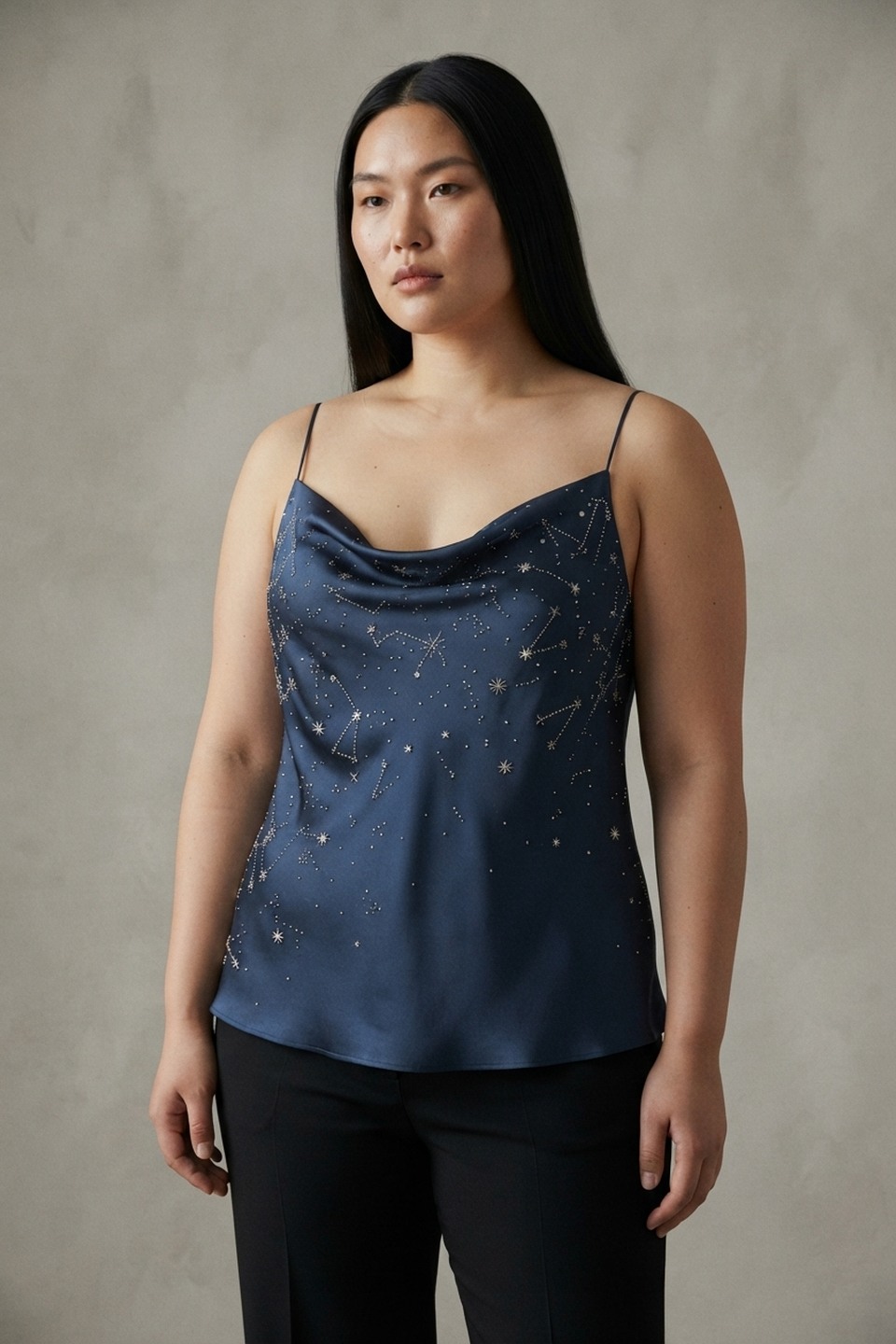
On the straight grain, the pattern imposes a silhouette. On the bias, the cloth, the body, and gravity all get a say. A skirt narrows where the fabric stretches downward and widens where it has to travel around the hips. A cowl neckline forms because extra diagonal cloth collapses into folds. A seam spirals if the pull on either side isn’t balanced.
That effortless look costs attention. Bias-cut pieces can lengthen while hanging, so check the hanging garment before leveling and sewing its hem. The time it needs depends on the fabric and construction. Slippery cloth can shift under the needle; unsupported diagonal seams can stretch. Test with the intended fabric before committing to the cut.
Knits replace the grid with a field of loops.
A knit is built differently. Instead of crossing two sets of yarn, it pulls one loop through another. The loops open, close, and distort, which is why a plain cotton T-shirt stretches even though cotton fiber barely does. Rib knit adds columns that concertina outward and spring back, which is exactly what you want at a neckband that has to pass over a head and then recover.
Stretchy still has a direction, though. Jersey often stretches more across the body than down it; test both directions. Some knits curl at a cut edge. A tee can twist after washing because of yarn torque, fabric distortion, or cutting and construction issues. A wandering side seam is a reason to investigate, not proof of one cause.
Swapping fabric can require a different pattern or construction. A neckline designed for stable poplin may need support in fluid jersey. A close-fitting bodice that relies on knit stretch may be too tight in a non-stretch woven. Check the pattern’s fabric requirements, then test the substitution before making the whole garment.
Good drape begins with better verbs.
“Flowy” and “structured” are fine places to start, but they hide the real questions. Should the cloth swing away from the legs or cling and release? Should a fold stay crisp when you pinch it, or dissolve? Should the surface feel dry, cool, papery, or slick? Does it need to recover after a day of sitting?
A designer turns those answers into construction. Crisp volume might mean organza, taffeta, interfacing, or just more distance between body and garment. Fluidity might come from a fine weave, a heavy yarn, a bias cut, or knit loops. Two fabrics can look identical in a photograph and move like different species.
So test cloth in motion. Hang it. Crush it. Fold it over an edge. Hold it up to the light. Your hands will learn things the product description left out.
A pattern is geometry. A garment is geometry plus gravity.
That’s the leap from drawing clothes to designing them. The line on paper is a proposal. Grain decides how much of it survives once the cloth adds bend, weight, and friction.
Once you notice that, fabric stops being a color swatch. Pick it up, pull it corner to corner, and it will show you which way it wants to go.