The architecture of carrying things
A pocket is a tiny room.
It has an entrance, walls, a floor, and a job. Move any one of them and you change what a garment can carry, and how a person moves through the day.
“Does it have pockets?” sounds like a yes-or-no question. It isn’t. A pocket can exist and still fail: too shallow for a phone, too narrow for a hand, placed where the contents knock against your thigh, or angled so everything slides out into the sofa.
A useful pocket has to satisfy the hand and gravity at once. The opening has to be where the hand goes. The bag has to hold weight without dragging the garment out of shape. And it has to sit somewhere the body can bend, sit, and run without spilling it.
That makes a pocket less an accessory than a piece of architecture: private space inside public clothing. And, like most architecture, access to it has never been shared out evenly.
Pocket lab · an inside view
Where does the room go?
A patch pocket builds storage on the outside. An in-seam pocket hides a bag behind an opening. Separate the layers to see what your hand actually enters.
A construction diagram. This shows how pieces connect, not a sewing pattern or a load simulation. Spacing is exaggerated; the in-seam garment panels are flattened into one plane. Seam allowances, interfacing, lining and optional waist anchors are omitted.
Your hand goes between the patch and the garment. The top edge is open; the side and bottom stitches attach the patch to the garment. The upper corners need reinforcement because the opening is repeatedly pulled.
- 1
Garment panel
The garment itself forms the back wall of this unlined patch pocket.
- 2
Patch
A separate piece forms the front wall. Its sides and bottom attach to the garment; its finished top stays open.
Before the pocket went inside, it was tied to the body.
From about the seventeenth century, many European women wore separate pockets: fabric bags tied around the waist under the petticoats, reached through slits in the layers above. They held money, sewing tools, food, spectacles, letters, keepsakes. The ones that survive range from plain sturdy cloth to dense embroidery.
Men’s coats, waistcoats, and breeches had sewn-in pockets much earlier. That gap usually gets flattened into “women never had pockets.” The stranger truth is that many women had big, portable storage. It was just a separate system, hidden under the fashionable silhouette.
As dresses narrowed, tie-on pockets got harder to reach. Handbags took over, and pockets sewn into women’s clothing stayed hit-or-miss. There’s no clean line from deprivation to liberation here, just a long tug-of-war between silhouette, status, privacy, and who is expected to carry what.
Every pocket edits the silhouette.
The most discreet is the in-seam pocket: an opening hidden in a seam, with the bag floating inside. It keeps the outside line clean, but put a heavy phone in it and the seam gapes. A slant pocket is easier for the hand to find, and its diagonal opening shows. A welt pocket cuts a precise mouth through the cloth. A patch pocket just adds another piece on top, and can make storage the whole look.
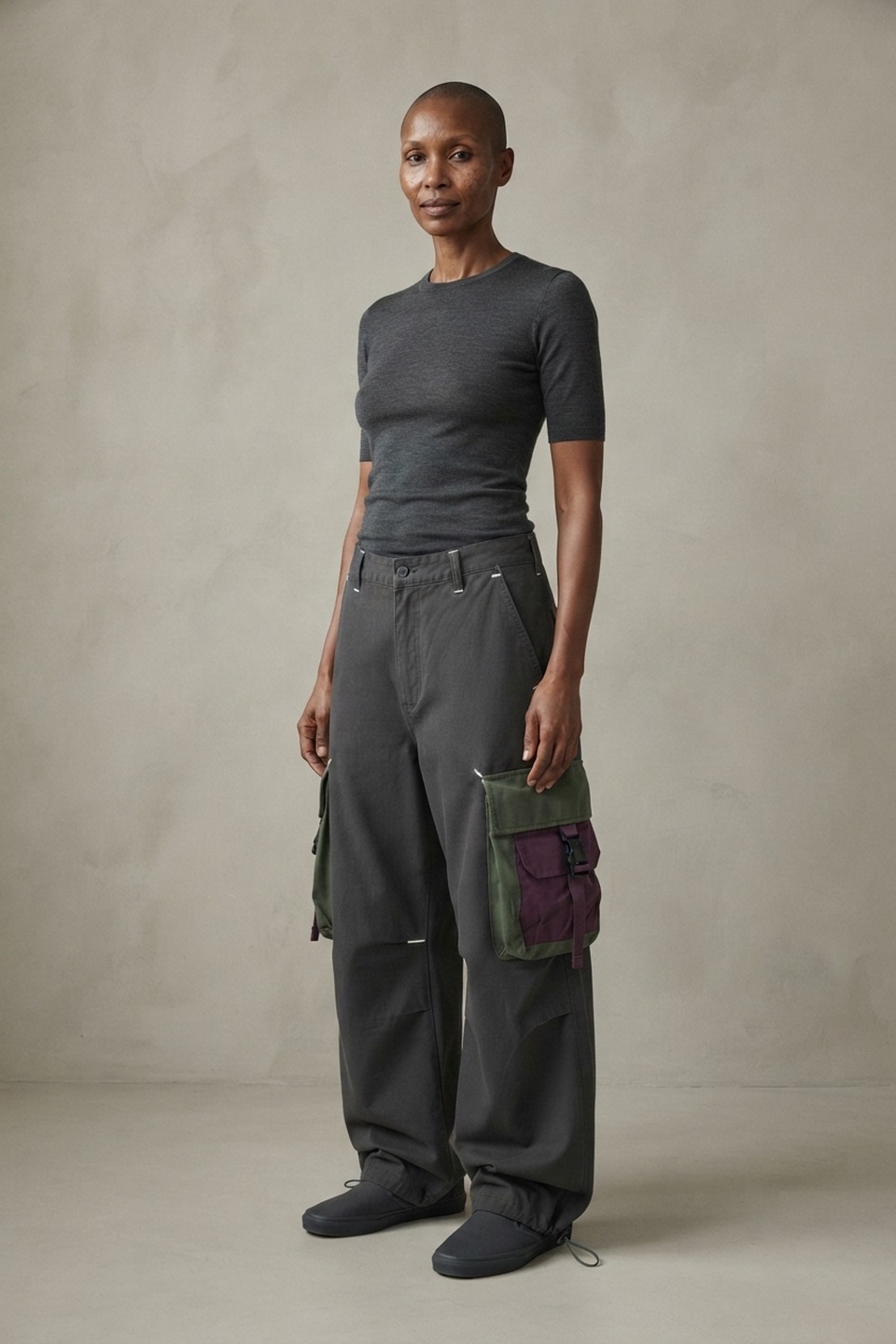
Then there’s volume. A flat patch holds very little before it pulls. Add a pleat or a gusset and the pocket expands outward like a bellows. Cargo pockets advertise capacity even when empty: their depth casts shadows, their flaps and snaps set a rhythm, and whatever’s inside changes the outline of the leg.
Placement changes posture. High hip pockets invite a thumb hook. Low pockets make the arm reach and visually lengthen the torso. A rear pocket punishes anyone who sits on a wallet. A chest pocket can hold a pen, frame a graphic, or be a false promise stitched shut.
Capacity has a structural cost.
Put 300 grams into a pocket and the weight has to go somewhere. In jeans, a patch pocket spreads the load through topstitching into dense denim. In a fluid dress, the same load pulls the side seam down and the whole skirt hangs crooked. The bag may need to anchor into the waistband or a facing instead of asking one soft seam to carry everything.
The opening takes a beating too. Hands pry it open all day. Phones lever against the corners. Bar tacks, those small dense blocks of stitching on workwear, sit exactly where things tear. The lining needs to be tough enough for keys, smooth enough not to snag them, and deep enough that sitting down doesn’t eject them.
Workwear got good at this because every pocket grew around a job: a ruler pocket narrow enough to stop a tool turning sideways, a kangaroo pocket that warms two hands, a cycling-jersey pocket you can reach behind your back, a passport pocket buried under layers and a zip. Function draws the silhouette. Fashion keeps quoting it long after the job has changed.
The contents complete the design.
A fashion photograph shows the empty garment. Life supplies the bulges: earbuds, medication, a smooth stone, receipts, dog treats, a transit card, the screw you meant to put somewhere safe.
Designers sometimes resist that mess because a loaded pocket wrecks a clean line. But clean for whom? A garment that needs a separate bag just moves the storage into another product, another purchase, another thing to keep track of.
So skip “pockets or no pockets?” Ask what this person should be able to keep close, which hand should find it, and what happens to the garment when they do. Start there and the pocket stops being a checkbox.
Independence can be measured in centimeters of usable depth.
A pocket lets a body carry its own small world, whether that world is a toolkit, a love letter, or half a granola bar. The design works when the room is where the hand expects it, strong enough for what matters, and invisible until it’s needed.
And yes: it should fit your phone.