How underwear became public media
The T-shirt became a printing press.
A blank cotton undershirt learned to broadcast bands, brands, jokes, grief, allegiance, and dissent. The medium worked because the message could walk away.
A poster needs a wall. A newspaper needs a reader willing to pick it up. A T-shirt only needs a torso. It carries its message into the street, onto a train, through a doorway, and occasionally into a room where the message wasn’t invited.
That mobility changed one of the simplest garments in the wardrobe. The tee started as a close-fitting underlayer, prized because knitted cotton washed well and didn’t restrict you. Worn alone, it showed what respectable clothing was supposed to cover. Printed, it turned the body into a publishing surface.
The result is a hybrid, half garment and half sentence. You judge the fit with your body and the graphic with your eye, and the meaning happens where the two meet.
First, the underwear had to become visible.
The T-shirt’s origin is messy, because useful objects rarely wait for a single inventor. It came out of knitted underwear, military issue, sportswear, work clothes, and mass manufacturing all at once. The T-shaped pattern gave you mobility from very few pieces and seams. Cotton knit soaked up sweat, survived the wash, and sat comfortably under a uniform.
Bringing that layer outside changed its charge. The V&A describes the tee as the textbook case of underwear becoming outerwear: a break with old rules about hidden clothing and, by the mid-twentieth century, a newly direct display of the male body. A blank tee said something before anyone printed on it. It said work, youth, heat, rebellion, or that the laundry wasn’t done.
Because the shape was standardized and cheap, it made an ideal blank. A little ink could turn thousands of identical shirts into souvenirs, uniforms, ads, or declarations.
Screen printing made repetition feel handmade.
In screen printing, ink is pushed through the open areas of a mesh stencil onto the fabric. Each color needs its own screen and its own pass. The image builds up in layers: print, cure, line up the next screen, print again. Misalign a screen and you get a colored halo. Too much ink and the print sits on the chest like a stiff plate. Too little and the cloth shows through.
Those limits became a look. Bold shapes and a few flat colors read across a room and forgive an uneven surface. Halftone dots fake a gradient with one ink. Discharge printing pulls the dye out of dark cloth instead of stacking an opaque layer on top. Water-based ink sinks in; plastisol sits on the surface. You can feel the message as well as read it.
Digital printing changes the deal: full color, no separate screen per layer. Transfers, flock, foil, embroidery, and appliqué each have their own texture. But every one of them still has to live on cloth that moves and stretches. A graphic on paper stays rectangular. A graphic on a chest breathes.
The body supplies context no designer can control.
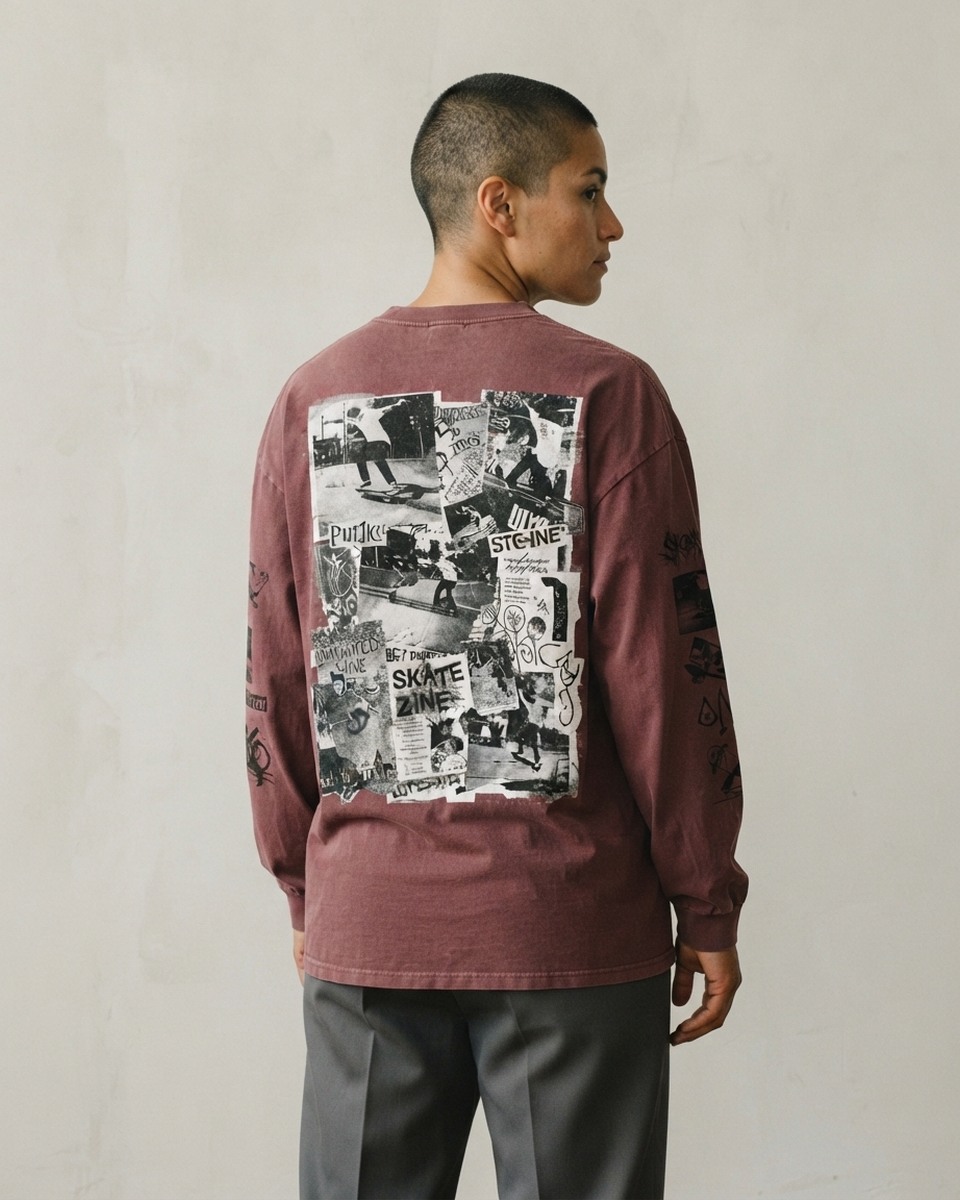
Print the same word at the center chest, across the shoulders, and around the hem, and you get three different statements. Scale sets the distance: a small mark asks people to come closer, an oversized image claims the room. Placement borrows the body. A mouth opens over the sternum. Eyes stare from the back. Type bends around a rib cage and vanishes into an armpit.
Then the wearer edits it. They crop it, layer it under a jacket, wash it until it fades, or keep it pristine. The shirt outlives its moment. A tour tee becomes proof you were there, then a vintage commodity, then an image worn by someone born after the final encore.
That instability is part of the medium. A slogan can be sincere, ironic, historical, or just decoration, depending on who wears it and who’s looking. Designers control the file. They don’t control the sentence forever.
Wearable media can enter places other media cannot.
Museums collect protest tees because ordinary cotton has carried a lot of public speech: student organizing, feminist declarations, labor campaigns, public-health activism, civil rights. The National Museum of American History keeps them as political objects in their own right, evidence that taking part leaves physical traces.
The tee is especially good at group messages. Give the same shirt to 500 people and the crowd becomes a repeated graphic. Let each person style it their own way and the uniform becomes a coalition. It’s cheap, portable, and reusable. It raises money, spots allies across a room, and makes an invisible constituency suddenly countable.
Commerce spotted the same power. Logos recruit bodies as distribution. Band shirts turn affection into affiliation. Souvenir shirts pin a place and a date to cotton. Same mechanism; only the message and the relationship behind it change.
The most personal billboard is still clothing.
A good graphic tee works twice. From across the room it has signal: shape, contrast, a reason to look. Up close it pays off with texture, a line of text, a detail. And on a body it gets the one thing a poster can’t: a person who chose to carry it.
So start further back than “put this image on a shirt.” Ask how loud it should be, from what distance, in which ink, and what the shirt itself adds. The press is ready. The page has sleeves.